Choice for Consumers, Competition for the Market: Improving the Rail Ticketing Regulation
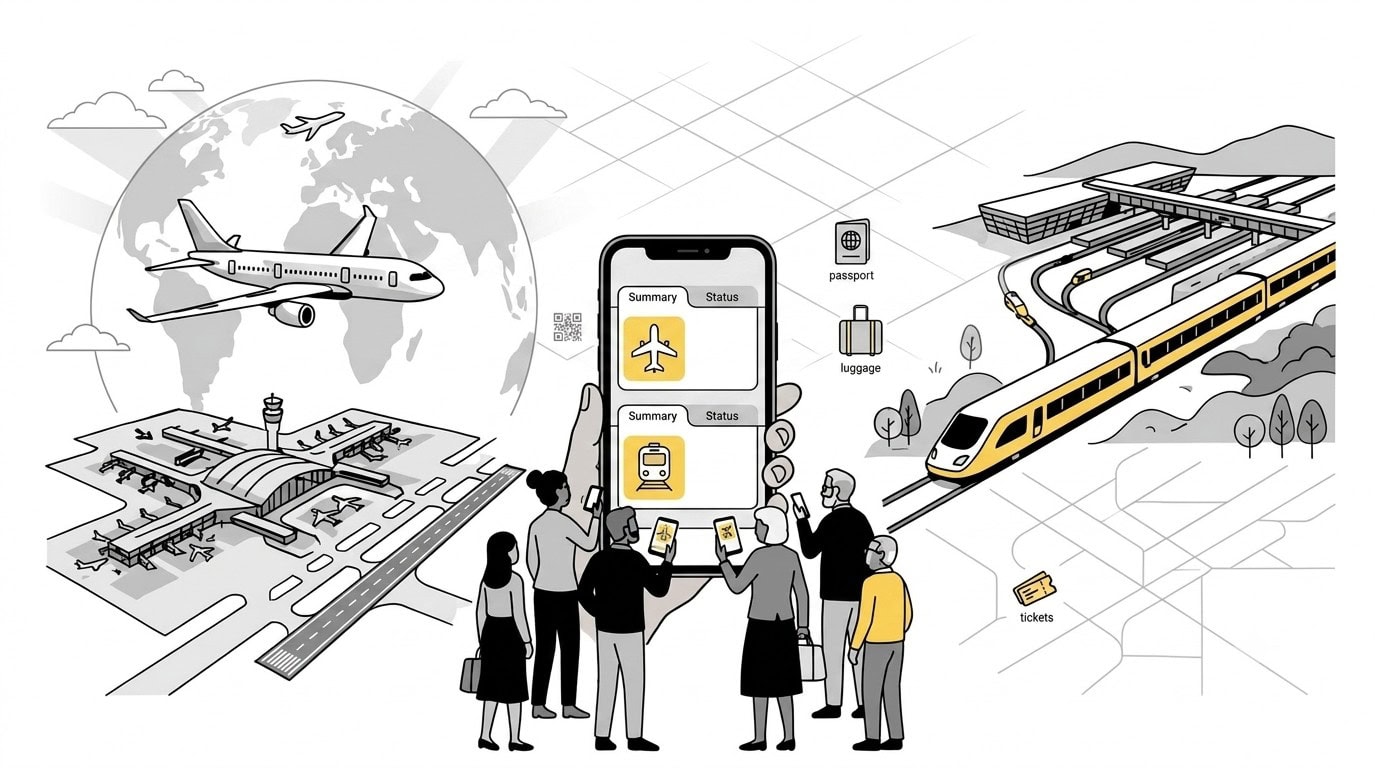
Across Europe’s transport markets, dominant operators keep their offer to themselves. Through unfair contractual conditions, unviable commission levels, restrictive technical limits, look-to-book ratios not adapted to multimodal travel searches and limiting access to fares, they stop independent ticketing platforms from offering a complete, comparable picture of their options. This limits comparability, hinders competition and harms consumers, who cannot reliably find the best ticket.
→ Well-documented market failure addressed only case-by-case so far across Europe, requiring systematic regulatory intervention.
→ It should be extended to aviation, where dominant airlines use the same practices.
→ The hosting obligation risks undermining the entire proposal.
Forcing dominant railways to share their content under FRAND terms is the right fix
For the first time, independent platforms would have a workable basis to negotiate viable agreements with incumbents and bring more transparency and comparable offers to passengers.
FRAND is the right standard because it is robust and hard to circumvent. It tackles what matters most: remuneration set too low for distribution to be viable; technical limits that penalise how consumers search and compare; look-to-book ratios not adapted to multimodal travel search, and content withheld so the best fares and features appear only on the operator’s own website. A clear, enforceable FRAND framework, including on remuneration, presents a systemic solution to a systemic problem and aligns rail with the EU’s wider approach to fair data access. FRAND protects every party involved, ensuring the relationship between platforms and operators is functional and conducive to a diverse distribution ecosystem.
→ Preserve a strong content-sharing obligation built on FRAND, including viable remuneration and adequate look-to-book ratios comparable to those widely used in air ticket distribution.
Extending the content-sharing obligation: no free pass for airlines
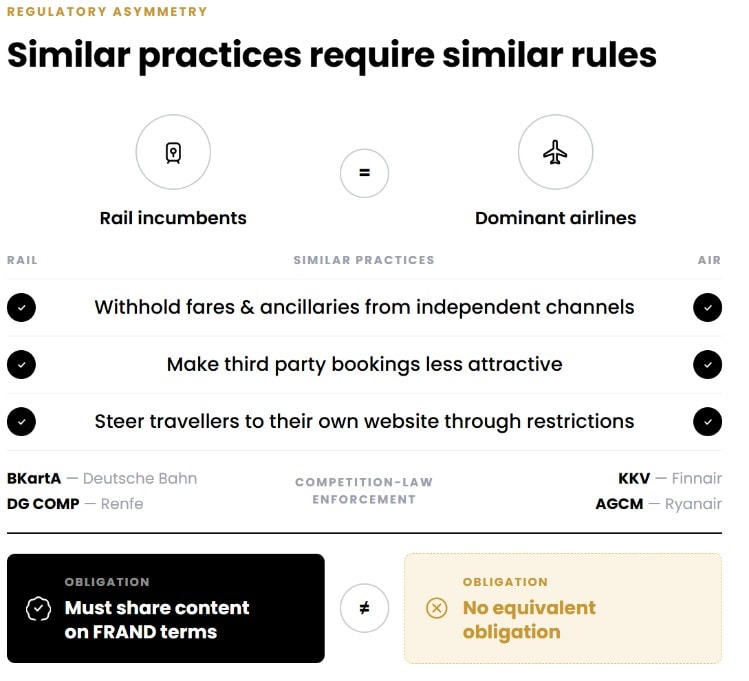
Dominant airlines pursue the same strategies as incumbent railways: withholding fares and ancillaries, surcharging indirect bookings, and steering travellers to their own websites. Confining the obligation to rail leaves that problem untouched and creates an unlevel playing field between modes, in which railways must open up their content while airlines need not. Railway operators must play fair; the same should go for airlines. This matters most for the EU’s multimodal ambition. Travellers can only shift from air to rail, or sensibly combine the two, if they can compare both fairly on price, journey time and sustainability in one place; exactly what airline restrictions prevent. While the best air offers sit only on the airlines’ own websites, consumers cannot find the comparable, multimodal itineraries that make modal shift real. The consumer harm is identical to rail: fragmented information, distorted prices and fewer options. A framework that fixes one mode but not the other is incomplete. Put simply, airlines must be prevented from punishing consumers for comparing their offers.
→ Extend content-access and FRAND obligations to dominant airlines on equal terms with rail.
Hosting obligation – inconsistent and perilous for independent platforms
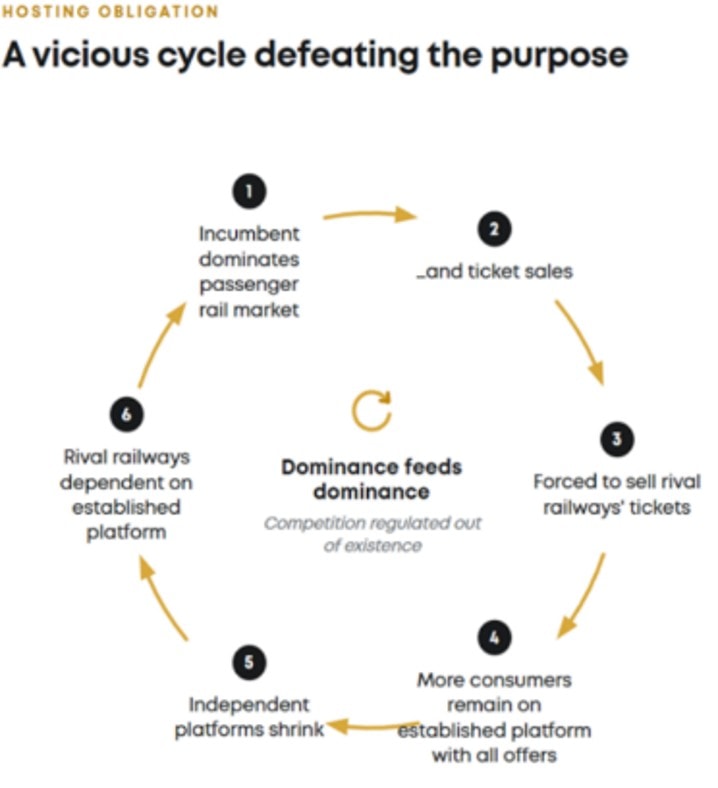
The hosting obligation would compel dominant railways to sell their competitors’ tickets through their own platforms. Far from opening the market, this will entrench the incumbent’s grip on distribution and squeeze out independent platforms. This is the exact opposite result of what the rest of the proposal rightly seeks to deliver.
The danger is straightforward: turning even more incumbents’ websites, already dominant, into gatekeepers for rail ticketing, notably for national rail travel (90% of the market) while all other distribution channels lose ground. Independent platforms will lose one of their selling points: comparison. Competing solely on quality is not yet an option, as the incumbent can prevent third parties from introducing the most basic features, such as the ability to process a refund request. Ultimately, the dominance that incumbents enjoy on the tracks will be replicated in distribution – with the same negative consequences for competition, innovation, and ultimately customers.
The Swedish Competition Authority warned of exactly this: selling all operators’ tickets mainly through the incumbent’s websites risks cementing this market structure, hands the incumbent power over its competitors’ conditions, and discourages investment in competing platforms. There is no need to run this risk. Italy and Spain have shown that vibrant passenger rail competition can exist without such red tape. In recent years, several new entrants have launched and many are expanding their services, as is the case for example for Flix. Clearly, they are able to reach customers – also thanks to independent distributors.
The hosting obligation has no parallel in other sectors; Ryanair is not obligated to sell EasyJet’s tickets and IKEA is not obligated to sell Conforama’s furniture. It contradicts the goals of the sharing obligation: two steps forward, one step back is not a sensible approach for EU rail distribution policy.
→ Remove the hosting obligation, which risks cementing incumbents’ dominance and pushing out independent platforms.