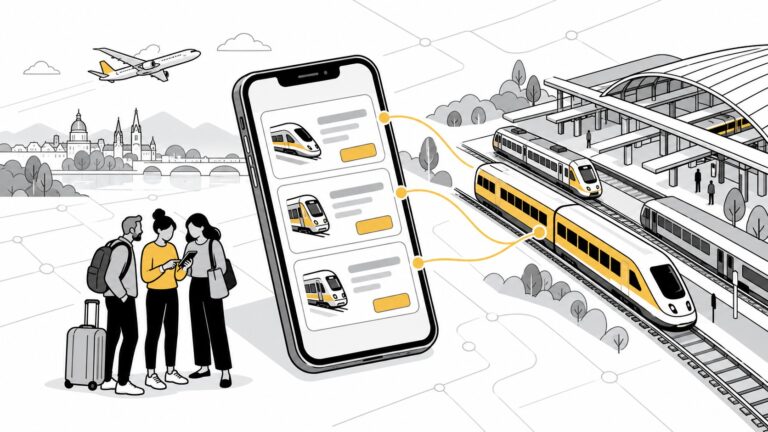
Europe must protect travellers’ freedom to compare and combine travel – across transport modes

Every airline wants passengers to book tickets on its own website; that is fair enough. However, Italy’s competition authority recently found Ryanair has done so to the direct detriment of Italian travellers, in an abusive manner.
For travellers, the best journey is not always offered by a single company. It may combine a Ryanair flight with another airline’s return, or with an onward rail connection. Ticket platforms allow travellers to compare such options side by side and book them together. They also permit a transparent comparison between all types of offers, combined or not. Ryanair’s aggressive strategy to push people away from these platforms and towards its own website was the subject of an investigation by the Italian competition authority spanning over two years. In December 2025, it fined the airline €255 million for obstructing independent ticket platforms’ ability to sell its flights alongside other airlines’ flights and travel services.
The authority described a succession of obstacles deliberately introduced by Ryanair. From April 2023, passengers using ticket platforms faced extra facial recognition checks. Ryanair later blocked bookings, rejecting payment methods and deleting accounts. When it began offering partnerships to OTAs, in early 2024, access to their offers came with restrictions: the authority found that the airline switched booking access off and on to press OTAs into agreements which were more favourable to Ryanair.
Ryanair says it was protecting passengers from overcharging and ensuring it could contact them. Italy’s authority examined those arguments and found them hollow. Ticket platforms should be transparent about prices and provide the details needed for flight updates. But airlines must not get to decide which competing flights or other services passengers may compare and book alongside their own.
The authority ordered Ryanair to stop its unlawful conduct. Ryanair did begin to introduce technical changes in April 2025 but did not yet go far enough to restore effective competition. These proceedings show that better access and transparency for consumers can be upheld through competition law enforcement, but this entails lengthy, costly and uncertain investigations, one airline and one country at a time, that only arrive after the harm has been done.
The wider problem is straightforward: to be useful to consumers, travel platforms have to show the broadest possible choice of travel options. But dominant airlines, quite often in a monopolistic position on most of their routes, can reach passengers through their own websites – these airlines have a natural incentive to push travellers to places where transparent comparison and combination is impossible. Travel intermediaries need access to all air tickets whereas dominant airlines don’t need access to travel intermediaries. This imbalance leaves ticket platforms poorly placed to resist restrictive terms, and travellers with fewer options when those terms prevent flights from being compared or combined. Similar concerns have prompted action in rail: Germany’s competition authority intervened against Deutsche Bahn’s restrictions on ticket platforms, while the Commission secured commitments from Spain’s Renfe to share tickets and real-time information.
The Commission’s Passenger Package, presented in May, offers a way to address this problem in a systemic way across Europe. Its proposed Rail Ticketing Regulation would require rail operators to make tickets and the data needed to sell them available to ticket platforms on request, on fair terms. Sites would be free to combine rail services, while operators could still require reasonable technical, financial and security safeguards. Passengers would gain a wider choice of journeys and places to book them.
The accompanying Multimodal Booking Regulation takes a different approach. It adds new rules for platforms, governing how they display offers and, for some platforms, their contracts with airlines and rail operators. Airlines would gain protections against unfair terms imposed by platforms, yet neither proposal would require them to make their own tickets available on fair terms. The package therefore adds obligations for the businesses helping travellers compare flights, while leaving airlines free to decide whether, when and on what terms their flights can be compared at all. Put simply, the Multimodal Booking Regulation would not have prevented a single one of the practices sanctioned in Italy. Nothing in it stops an airline from refusing to distribute its fares, switching booking access off and on, or making access conditional on terms it alone dictates. Rules on how platforms display offers mean little if those offers can be withheld in the first place.
Parliament and Council should close that gap by requiring airlines, like rail operators, to make their tickets and the data needed to sell them available to ticket platforms on fair, reasonable and non-discriminatory (FRAND) terms, with proportionate safeguards. Without such an obligation, access will continue to depend on each airline’s commercial goodwill, or on years of competition proceedings. Ticket platforms need reliable access to fares and booking systems, and the freedom to combine flights with other travel services. That would also make it easier to book a multimodal journey, involving both a plane and a train.
The Commission has proposed clear and comprehensive rules to ensure that rail offers are easily accessible and comparable online. Travellers deserve the same benefits in terms of transparency and convenience for multimodal offers!