Multimodal Booking Regulation – Ensuring sensible ranking rules
Multimodal Booking Regulation – Ensuring sensible ranking rules
A proposal to co-legislators on Article 7 of the Multimodal Booking Regulation
1. Introduction
As representatives of a significant part of Europe’s mobility ecosystem, including passengers, business travelers, independent rail operators and ticket intermediaries, we support the objective of the Multimodal Booking Regulation: travellers should be able to find, compare and book journeys across operators and modes, and rail and multimodal itineraries should be easier to discover.
To achieve this goal, we believe the proposal’s display rules should enable consumer choice and efficient ranking of offers. We propose three targeted amendments that achieve the objective of transparency and consumer choice while avoiding the current drawbacks. As the Multimodal Booking Regulation and the Rail Ticketing Regulation form a closely interlinked package, both proposals should be discussed alongside each other.
The Multimodal Booking Regulation’s rulebook for the display of transport offers
▪ Article 7(2): display “in a neutral and comprehensive manner, without discrimination or bias”.
▪ Article 7(4): no ranking factor “directly or indirectly related to the transport operator’s identity”.
▪ Article 7(5): the default ranking is confined to a closed list of seven criteria.
▪ Article 7(10): other criteria only “if explicitly requested”.
2. Limitations of the proposal
Useful default ranking factors would not be possible
Online transport ticket platforms use a variety of factors to rank offers across air, rail, and road. Among these factors are those permitted in the default ranking by the Regulation: mainly price, journey duration, departure time. But many other factors are routinely used, including punctuality, cancellation rates, reliability, transfer time, customer ratings. Platforms also use diversity as a relevant factor, to ensure that a consumer does not see overly similar results many times in a row.
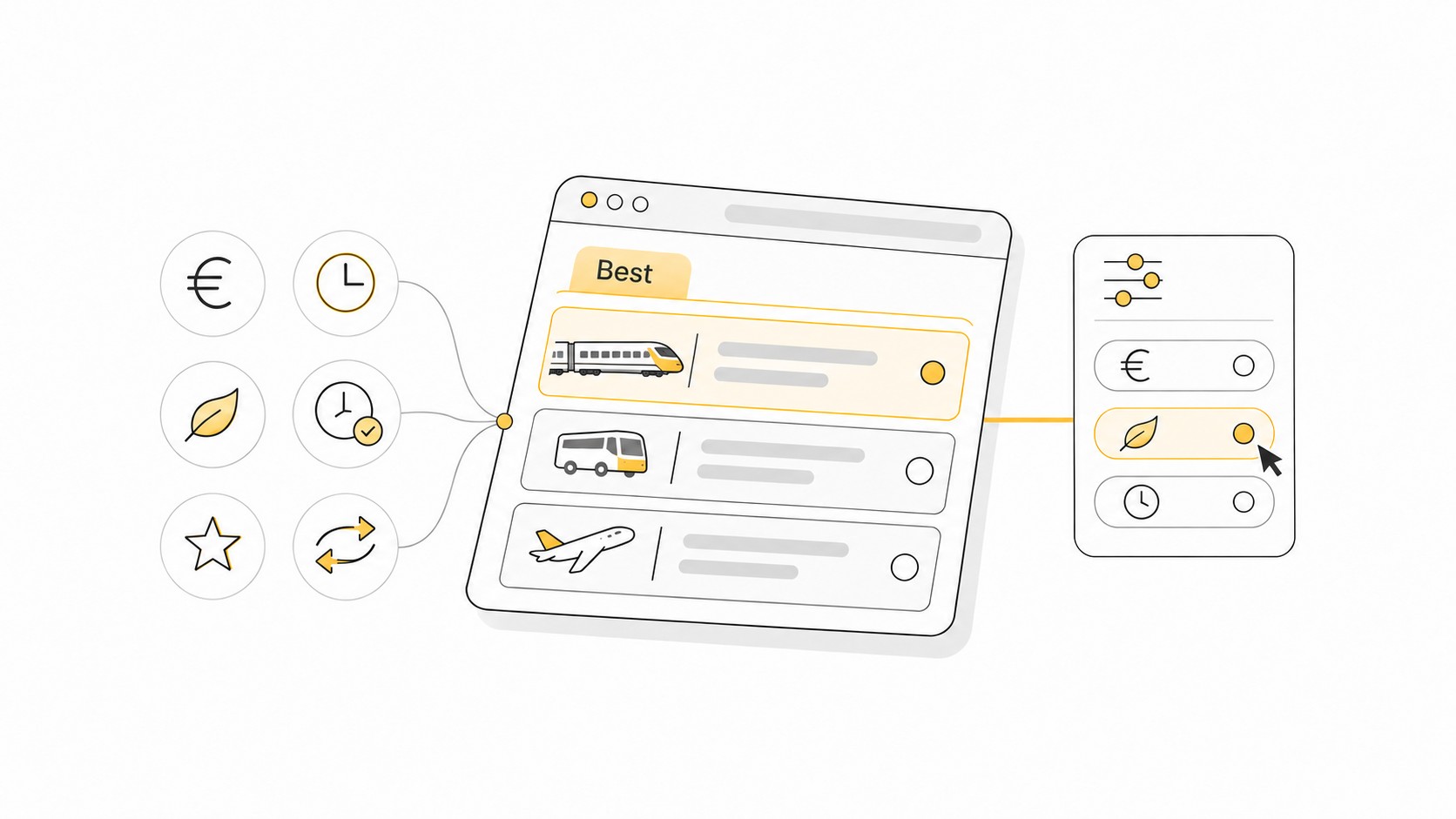
One of the main tasks of platforms is to synthesise offers in a convenient ranking and display which considers a wide range of factors. This leads to the ‘best’ ranking. Particularly in a multimodal context with thousands of possible itineraries, and provided consumers are aware of the factors used and are empowered to select them differently, such ‘best’ rankings allow them to see the most relevant results at the top of the query results.
A platform offering a default ranking using such useful factors would violate the Regulation.
Prohibitions go beyond their objectives
The display obligation’s central aim is to “protect the interests of consumers” by ensuring that “no transport operator is unfairly favoured over another transport operator”. The proposal does not pursue this intent with sufficient clarity and instead introduces rules which reduce the range of choices and transparency available to passengers. Stated plainly, the Regulation should only prohibit ranking which discriminates between transport operators based solely on their identity; currently it prohibits ranking based on what operators offer in terms of quality, ratings, and many other factors.
Nonetheless, the issue that offers of one transport operator could be unfairly favoured over another is currently problematic mainly in a much narrower context: self-preferencing by rail platforms owned by railway undertakings that compete with the operators whose services they sell. This problem arises in one transport mode and among a limited number of platforms, which the Rail Ticketing Regulation already identifies as indispensable railway online ticketing service providers.
3. What we propose
In 2023, the Commission tasked an expert group of stakeholders[1] with questions on this exact topic. The Multimodal Passenger Mobility Forum’s 2023 final report concluded that the right regulatory approach was mandatory ranking options. This means the Regulation would oblige platforms to provide consumers with the choice of ranking all offers by price, journey duration, departure time, and other factors. It would not prohibit platforms from offering a more complex default ranking which considers many additional factors.
Our suggestions:
- Transparency and non-discrimination: Platforms should be prohibited from ranking based on undisclosed factors or discriminatory factors in the default ranking.
- Guaranteed ranking options for travellers: Consumers should be empowered to rank offers by criteria of their choosing, individually.
- Default rankings would remain open for consumers and platforms to use as they see fit.Self-preferencing by vertically integrated rail platforms addressed in the Rail Ticketing Regulation: A targeted prohibition of self-preferencing for indispensable railway online ticketing service providers in the Rail Ticketing Regulation.
The Multimodal Booking Regulation and the Rail Ticketing Regulation were proposed together as complementary parts of the same passenger package. Several of the issues above, including the treatment of vertically integrated rail platforms, can only be resolved coherently if both texts are examined alongside each other. We therefore call on the co-legislators to discuss the two Regulations in parallel. We further call on policymakers to take the time necessary to consider complexities of the sector and the proposed framework. The Multimodal Booking Regulation will bring significant impacts for operators, platforms, and most importantly passengers for many years to come, its provisions must be clear, easily enforceable and proportionate.