Insights from the HOTREC Hotel Distribution Study: OTAs market share stable, Google Hotels higher and higher.

HOTREC, the trade association representing the hospitality industry in Brussels, has just issued its biannual study on hotel distribution in Europe. Based on a broad survey of its members and conducted by an independent academic, it is always a very insightful piece for all industry players (even if, as with any survey, some methodological choices can be debated). eu travel tech commends HOTREC for feeding policy discussions on travel distribution with hard data. If there is one thing EU policymakers and stakeholders both like, it is to have evidence-based conversations!
Each side will highlight different conclusions; here is what caught my attention.
Hotel distribution market is now mature, with stable market shares over the last decade: ca. 50% for direct distribution by hotels, ca. 30% for Online Travel Agencies (OTAs)
With the emergence of the internet three decades ago, hotel distribution has been turned upside down. But, as with any revolution, it has landed on a new normal: direct channels (hotel website, phone, walk-in…) account for more than 50% of bookings and all OTAs combined for ca. 30%, with no significant upward or downward trend over the last decade. The remaining 20% come mostly from traditional travel agencies.
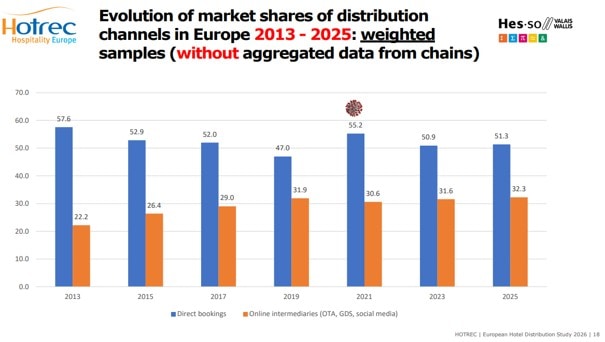
Such stability is even more surprising given the arrival of a new generation of consumers with allegedly new online habits. Maybe GenZers are not that different from Millennials!
However, AI may bring a new revolution in the coming years. New AI tools are bringing new ways to look for hotels and tomorrow to book them. How it will impact hotel distribution is still unclear (see my recent op-ed) but expect changes!
Google is killing the hotel meta game, making the implementation of the ban on self-preferencing more important than ever
A hotel meta search engine lets users compare prices for the same room from different sellers, before booking with an online travel agency or on the hotel website. On this market, Google Hotels is competing directly with Trivago, TripAdvisor or Kayak.
But Google Hotels has one huge advantage over its competitors: it is prominently displayed on the general search results page of Google Search, the globally dominant search engine with 90%+ market share in most markets. This “self-preferencing” is what explains the tremendous uptake of Google Hotels since 2013, as shown by the HOTREC study. Instead of competing with other meta search platforms by offering more innovative and attractive services, Google Hotels is simply riding on the unassailable market power of Google’s search business.
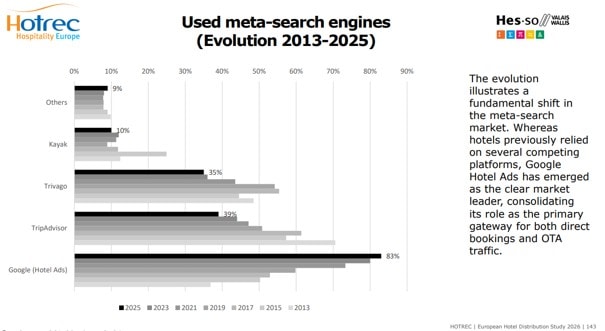
As the study rightly points out, Google has imposed its meta search to all, hotels and OTAs, as “the primary gateway” to get traffic. This is bad for competitors and, more importantly, for competition: 87% of hotels use Google’s services, with other meta search engines trailing far behind, which leaves hotels fully dependent on it for traffic. This comes on top of hotels’ dependence on Google Search and Google’s advertising services.
Such self-preferencing has been considered anticompetitive since 2018 and the Google Shopping case and has been banned under article 6.5 of the Digital Markets Act (DMA) since 2024. The data shows enforcing this ban is more needed than ever!
But to this date, Google still refuses to comply with the DMA rules. Last July, the Commission imposed a €470 million fine to Google, giving it 60 days to finally comply, before facing periodic penalties. The 60 days are up, and Google is still playing around, refusing to fully comply. The Commission shall take action right away!
This Op-Ed has been authored by:

Emmanuel Mounier, Secretary General of eu travel tech