Stronger Rights for Rail Passengers, Workable Rules for the Rail Market

Today, passengers who combine trains from different operators to complete a single journey too often travel without the protection they would enjoy on a single operator’s service. If a leg is delayed or cancelled, they can be left stranded, out of pocket and uncertain about who is responsible for providing assistance or compensation. This protection gap may discourage travellers from booking multi-operator, cross-border rail journeys, and slow the modal shift from air and road to rail.
eu travel tech strongly supports the Commission’s objective of making multi-operator rail journeys easier to book and more reliable. We welcome the proposal’s recognition that the core liability for missed connections should fall on the rail operators who run the services. Liability cannot fall on the intermediaries who sold the ticket, as they have no control over disruptions and can do nothing to prevent them.
eu travel tech’s key asks:
→ Preserve the proposal’s ambition of making multi-operator rail journeys more attractive by laying down a clear, proportionate and economically viable liability framework for railway operators.
→ Narrow the anti-circumvention clause to target only the deliberate segmentation of multi-operator rail journeys to avoid liability, rather than imposing a de facto obligation to combine every technically feasible itinerary into a single ticket – which would be very difficult to implement in practice.
A clear and proportionate liability framework keeps multi-operator rail journeys attractive
eu travel tech is concerned about the potential for confusion and friction in implementing the new framework. Any gaps, inconsistencies or uncertainty can lead rail operators to delay or refuse assistance or compensation, creating disputes. If the rules are unclear or subject to interpretation, intermediaries will struggle to inform and assist passengers properly. This can ultimately undermine the effective enforceability of these rights. eu travel tech also worries that the heightened liability this proposal places on railway operators for missed connections may make them reluctant to have their tickets combined with those of other railways, and could prompt them to discourage or prevent such combinations by whatever technical or contractual means they can. This could notably include prolonging minimum connecting times (MCT) beyond what is reasonable. EU lawmakers should remain vigilant and ensure there is no space for such behaviour.
Nor should lawmakers lose sight of the proposal’s central purpose: making multi-operator rail journeys more attractive. Stronger passenger rights should serve that goal, but these journeys must also remain commercially attractive and financially viable for the operators that run them. A proportionate and economically viable liability framework would give rail operators every reason to combine their services, and to let intermediaries combine them with those of other railways, leaving travellers with more options and better-integrated rail itineraries.
A well-intentioned anti-circumvention clause, but too broad to work
The “anti-circumvention clause” in Article 12(3)[1] is well intentioned, seeking to prevent sellers from segmenting a multi-operator rail journey into separate transactions, or selling its legs separately, when those legs could be offered together as a single ticket. That makes sense for railway operators, which might be tempted to split a multi-operator journey precisely to avoid liability for a missed connection. For intermediaries, however, it makes far less sense: they have every commercial incentive to sell the ticket carrying the strongest passenger rights, because that is the better product for their customers.
Yet, as drafted, the clause is too broad and impractical. Given the countless ways in which services from different railway operators can be combined, a given combination may be technically possible, yet not surfaced in the results because it is not the most relevant, practical or attractive option. Finding, selecting and ranking rail itineraries is an inherently complex technical task, and no vendor can realistically surface every possible connecting option. Take a traveller going from Amsterdam to Milan. Depending on the date, time and price, that trip can be assembled from the services of several national operators, connecting at any one of a dozen cities, in a very large number of valid combinations. Some “on paper” combinations might not appear because they are not practica, for example those with hours-long connecting times between two short legs.
The practical difficulty of such an obligation is also illustrated by comparison with the air sector. Air travel routinely involves itineraries that can ultimately be combined into a single booking or transaction, yet there is no equivalent blanket prohibition requiring sellers to combine every technically feasible itinerary into a single transaction. Instead, the market relies on clear liability rules rather than an obligation to surface or package every possible combination. Rail should follow a similarly proportionate approach by targeting only deliberate segmentation intended to circumvent passenger rights.
Should the clause remain as currently drafted, it would expose vendors to non-compliance simply for performing their role of selecting the most relevant and appropriate itineraries for consumers.
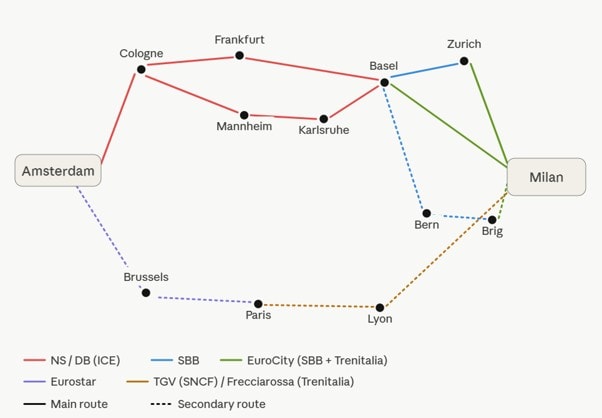
No ticket seller could realistically meet such an obligation. The clause should therefore be narrowed to target only the deliberate splitting of a multi-operator rail journey to avoid liability, rather than creating a de facto obligation to identify and package every theoretically possible combination of rail services. Such a targeted approach would better reflect the realities of how rail transport distribution works while still preventing circumvention of rail passenger rights.
[1]“When offering tickets, railway undertakings, ticket vendors and tour operators shall not segment or sell under separate commercial transactions any journey which can be sold under a single ticket.”